

Explore our coast
Places to discover. Events to experience.
We’re developing The Doric Way to connect more than paths. We want it to help people discover the landscapes, wildlife, harbours, communities, culture and traditions that make our coastline so special.
Whether you’re planning a day out, a weekend away or just looking for somewhere new to explore, you’ll find plenty of ideas here while The Doric Way continues to grow.
.jpg?width=1600)


Plan a coastal visit
Find the places and traditions behind the route
There’s already so much to see and do along our coastline. From beaches, wildlife and fishing villages to museums, festivals and community traditions, these are places and activities along the coastline The Doric Way aims to connect. Event dates, opening times and access information can change, so please check with the organiser, venue or route publisher before travelling.
01 · Places to see and things to do
Discover the places that shape our coast
From tidal wetlands and shifting dunes to working harbours, fishing villages, museums, beaches and cliff-top castles, there’s an extraordinary amount to discover along our coastline.
Choose an area below to see what’s there. Some places sit directly beside sections of The Doric Way, while others are nearby and well worth exploring as you travel along the coast.
Choose a stretch of coast to see the full list for that area.
Showing six highlighted places. Choose an area to filter the full list.

Nature · Tidal estuary
Montrose Basin
Where the South Esk reaches the sea, the tide moves through a narrow entrance into a broad, near-enclosed basin of mudflat, saltmarsh and open water. The changing water levels reveal rich feeding grounds for waders and wildfowl, while ospreys can be seen fishing here in summer.

Nature · Geology
St Cyrus National Nature Reserve
A line of ancient volcanic cliffs shelters dunes and flower-rich grassland from the harsher North Sea weather, creating an unusually warm coastal microclimate. Many plants reach the northern edge of their British range here, alongside rich butterfly and moth life and wintering shorebirds.

Community hub · Dolphins and marine life
Greyhope Bay
At Torry Battery, the off-grid Greyhope Bay Centre looks across the entrance to Aberdeen Harbour, one of Scotland’s best-known year-round places to watch bottlenose dolphins. Its café, community programme and marine education work connect people with the city’s coast, wildlife and maritime setting.

NatureScot · Dunes and estuary
Forvie and the Ythan Estuary
Forvie protects almost 1,000 hectares of shifting dunes, dune heath, cliffs and estuary. It supports Scotland’s largest mainland tern and gull colony, internationally important waterfowl and a major grey-seal haul-out; the dunes also preserve the ruins of Forvie Kirk and a settlement overwhelmed by sand.

RSPB · Gannet colony
RSPB Troup Head
Cliffs rising to more than 90 metres hold Scotland’s largest mainland gannet colony, together with kittiwakes, guillemots, razorbills and puffins. The exposed headland also gives long views across the Moray Firth, where dolphins, porpoises and minke whales may be seen offshore.

Landscape · Railway heritage
Cullen Beach, Viaducts and the Three Kings
Cullen’s sweep of sand is framed by the Three Kings sea stacks and the great arches of the former coastal railway. Nearby, the medieval Auld Kirk holds a memorial to Elizabeth de Burgh, queen of Robert the Bruce, bringing together geology, transport history and the long story of the town.
Explore 61 more coastal places Show fewer places
The Mearns and Stonehaven
From working fishing harbours and community museums to nationally important history and seabird cliffs.

Community heritage · Harbour
Benholm and Johnshaven Heritage Centre
Housed in the village’s former lifeboat shed, the centre looks across Johnshaven Harbour and records the industries, families and everyday working life that sustained this small coastal community. Its setting makes the connection between local memory, the harbour and the changing economy of the Mearns especially clear.

Fishing heritage · Lifesaving
Gourdon Harbour and the Maggie Law Maritime Museum
Gourdon remains a working fishing harbour, with boats, creels and shore-side activity still shaping the village. In the former coastguard building, the museum preserves the Maggie Law, an inshore lifeboat built in 1890, rowed by six men and credited with saving 36 lives during four decades of service.

Maritime history · Pebble shore
Inverbervie
Inverbervie’s pebble shore sits beside a town with a striking link to the age of sail. Local-born naval architect Hercules Linton designed the tea clipper Cutty Sark; his memorial near the Jubilee Bridge incorporates Nannie, the figurehead inspired by Robert Burns’s Tam o’ Shanter.

National history · Community stewardship
Kinneff Old Church
Kinneff became part of Scotland’s national story in 1652, when the Honours of Scotland were hidden here after being smuggled out of besieged Dunnottar Castle. The small church now interprets that episode alongside the history of the neighbouring coastal and fishing communities.

Fishing village · Art and culture
Catterline
Catterline sits above a small harbour long associated with fishing and an early Christian tradition linked to St Ninian. In the 20th century its exposed setting, changing light and working landscape drew Joan Eardley and other artists whose work became closely identified with the village.

RSPB · Seabird cliffs
RSPB Fowlsheugh
More than 115,000 breeding seabirds crowd these 30-metre cliffs in spring and summer, making Fowlsheugh the largest mainland seabird colony on Scotland’s east coast. Guillemots, razorbills and kittiwakes dominate the ledges, with smaller numbers of puffins and fulmars.
Working harbour · Town heritage
Stonehaven Harbour, Beach and Tolbooth
Stonehaven’s sheltered harbour remains active with fishing boats and leisure craft. The community-run Tolbooth, the town’s oldest building, has served as a storehouse, courthouse and prison; in season, the much-loved land train helps connect the harbour and seafront with other town attractions.

Social history · Art Deco
Stonehaven Open Air Pool
Opened in 1934 after local residents backed the idea, this Art Deco lido was built to competition dimensions and still uses heated seawater. Its survival owes much to community campaigning and volunteer support, making it both a summer attraction and a strong example of local stewardship.

History · Fortress
Dunnottar Castle
Dunnottar occupies a naturally defended rock cut off from the mainland by steep cliffs and a narrow approach. Its history includes William Wallace, Mary Queen of Scots and Cromwell’s siege, when the Honours of Scotland were removed from the fortress and concealed at nearby Kinneff.

Museum · Archaeology, art and maritime history
Montrose Museum and Art Gallery
Founded in 1842 by the Montrose Natural History and Antiquarian Society, the museum occupies a Greek-inspired neoclassical building. Its galleries range from archaeology and natural history to the Marquis of Montrose, the Jacobite risings and the town’s maritime past, alongside changing art exhibitions.

Industrial heritage · Community restoration
Mill of Benholm
This Category A-listed watermill has roots stretching back centuries and continued milling oats until 1982. Its mill buildings, kiln, lade and waterwheel reveal how grain was processed in the Mearns, while community ownership is now bringing the long-mothballed site back into active use.

Lighthouse engineering · Exposed cliff coast
Tod Head Lighthouse
Designed by David A Stevenson and first lit in 1897, the short white tower stands high above the coast between Catterline and Kinneff. It was electrified in 1973, automated in 1986 and decommissioned in 2007, when its historic optic and clockwork mechanism were transferred to National Museums Scotland.

Aviation heritage · Community museum
Montrose Air Station Museum
On the site of Britain’s first operational military airfield, this volunteer-run museum brings together aircraft, reconstructed rooms, photographs and personal objects to tell the human story of RFC and RAF Montrose. Check the museum’s own website for current opening days before travelling.
Aberdeen and Formartine
An urban coast, major river mouths, extensive dunes and one of Scotland’s most important estuaries.
Wildlife · Coastal defence
Torry Battery and Girdleness
The former artillery battery overlooks the narrow entrance to Aberdeen Harbour and is one of the city’s best known viewpoints for bottlenose dolphins. Nearby Girdleness Lighthouse, designed by Robert Stevenson and first lit in 1833, reflects the hazards of this busy approach to the River Dee.

Museum · Maritime city
Aberdeen Maritime Museum
Set above the historic harbour, the museum brings together shipbuilding, fishing, clipper ships, port history and offshore energy. Its collections help explain how Aberdeen’s prosperity, architecture and working culture have been shaped by repeated changes in the city’s relationship with the sea.
_-_geograph.org.uk_-_7550375.jpg?width=1600)
City coast · Regeneration
Aberdeen Beach and the Links
The broad sandy beach and open Links form Aberdeen’s main public seafront. A major transformation is creating new public spaces, play and activity areas and better walking and cycling connections; check current council information for access and facilities while work continues.

Urban nature · River mouth
Donmouth Local Nature Reserve
At the mouth of the River Don, freshwater, tidal water, beach and dunes meet within the city. The reserve is used by seals, waders, gulls and other coastal birds, while its dune plants and shifting shoreline show how natural processes continue within a heavily used urban landscape.

Landscape · Dune system
Balmedie Beach and Dunes
Balmedie fronts part of the extensive dune system running north from Donmouth towards Forvie. Wind-blown sand builds and reshapes the foredunes, while older dunes behind support more stable grassland and heath, creating a clear sequence from active shoreline to established habitat.

Wildlife watching · Responsible access
Newburgh Beach and the Ythan seal viewpoint
Newburgh gives the safest public view across the Ythan mouth towards the large seal haul-out. An all-abilities boardwalk leads through the dunes to the viewpoint, allowing people to watch from the south side of the river without approaching or disturbing seals on the reserve shore.

Fishing village · Smuggling history
Collieston Beach and Harbour
Collieston’s small sheltered bay sits beneath a tightly gathered former fishing village. Local stories of smuggling reflect the hidden coves and difficult-to-police shoreline, while the harbour and nearby Forvie cliffs show how settlement, fishing and natural shelter developed together.

Landscape · Coastal settlement
Cruden Bay Beach
A broad arc of pale, pink-toned sand extends between Cruden Bay and Port Erroll, backed by dunes and the mouth of the Water of Cruden. The White Ladies Bridge provides a distinctive approach to a beach whose scale contrasts with the enclosed harbour and village behind it.

History · Literature
New Slains Castle
Begun around 1597 and extensively remodelled in the 19th century, New Slains stands roofless on the cliff edge. Bram Stoker stayed in Cruden Bay and visited the area; the castle’s dramatic setting and architecture are widely associated with the imaginative landscape behind Dracula.

Maritime history · Working port
Aberdeen Harbour
Established in 1136, the port has shaped Aberdeen for almost nine centuries. Medieval trade, fishing, shipbuilding, granite exports and North Sea energy have all left their mark; today the historic harbour and the deep-water South Harbour remain part of a living, working maritime landscape.

Geology · Seabird coast
Bullers of Buchan
The Bullers is a vast collapsed sea cave connected to the North Sea through a natural arch. Waves exploiting joints and weaker bands in the rock have created a dramatic chasm, caves, stacks and ledges used by nesting guillemots, razorbills, kittiwakes and occasional puffins.

Maritime safety · Stevenson engineering
Girdle Ness Lighthouse
Robert Stevenson’s 37-metre lighthouse was established in 1833 after repeated losses near Aberdeen Harbour, including the wreck of the whaling ship Oscar. Its original double-light arrangement was an important engineering innovation; the active Category A-listed tower still marks the Girdle Ness peninsula but is not open to visitors.

Secluded beach · Coastal geology
Hackley Bay
Hidden between Collieston and the Sands of Forvie, Hackley Bay is a small sandy cove reached on foot along the cliff coast. Tilted rock layers, caves and steep grass-covered slopes give the bay a secluded character, while the approach opens long views across the adjoining nature reserve.

Fishing heritage · Planned harbour
Port Erroll Harbour
The harbour at the mouth of the Water of Cruden was rebuilt between 1875 and 1880 with funding from the Earl of Erroll, giving Port Erroll its name. Its stone piers, small boats and former lifeboat connections preserve the maritime history that developed beside the broad sweep of Cruden Bay.

Fishing community · Maritime heritage
Footdee (Fittie)
At the end of Aberdeen Beach, the inward-facing squares, cottages and distinctive sheds of Footdee preserve the character of the city’s surviving fishing community. Fittie remains a residential neighbourhood, so visitors are asked to explore quietly and respect people’s homes and privacy.
Buchan and Peterhead
A coast of granite cliffs, major fishing infrastructure, community museums and internationally important wetlands.

Scottish Wildlife Trust · Geology
Longhaven Cliffs
This Scottish Wildlife Trust reserve protects pink-red granite cliffs rising to around 60 metres. Repeated wave action has opened joints in the rock to form caves, arches, stacks and narrow inlets, while spring wildflowers and nesting seabirds occupy the ledges and grassland above.
_(geograph_6212564).jpg?width=1600)
Social history · Harbour engineering
Peterhead Prison Museum
The museum occupies the former prison that operated from 1888 to 2013. Its origins are inseparable from the coast: the prison was built to provide convict labour for Peterhead’s huge harbour-of-refuge breakwaters, linking penal history directly with one of Scotland’s most ambitious marine engineering projects.

Fishing · Maritime engineering
Peterhead Bay and Working Harbour
Peterhead has had a harbour for more than 400 years and is now the UK’s largest fishing port, with major whitefish, pelagic and shellfish activity. Its immense breakwaters began as a Victorian harbour-of-refuge scheme and later created the sheltered deep water that supported fishing and offshore energy.

Museum · Exploration and fishing
Arbuthnot Museum
One of Aberdeenshire’s oldest museums, the Arbuthnot holds models showing the development of Peterhead fishing boats, historic photographs, coins and Inuit material connected with northern voyages and whaling. Together they place the town’s fishing story within a much wider history of trade and exploration.

Town beach · Marina
Peterhead Lido Beach
The small sandy beach lies within the shelter of Peterhead Bay, looking towards the marina and the great outer breakwaters. It offers a different perspective on the port: a public shoreline framed by the engineering works that transformed an exposed bay into a major harbour.

Community heritage · Former fishing village
Buchanhaven Heritage Centre
Created to safeguard the history of the former fishing village of Buchanhaven, the centre combines exhibitions on fishing families, local life and wartime experience with classes and community activity. It shows how heritage buildings can remain useful social spaces rather than becoming static displays.

RSPB · Coastal wetland
RSPB Loch of Strathbeg
Britain’s largest dune loch is surrounded by reedbed, wet grassland, dunes and open water. The reserve manages water levels and grazing for breeding waders and at least 20,000 wintering wildfowl, including the great autumn and winter gatherings of pink-footed geese.
.jpg?width=1600)
Engineering · Exposed coast
Rattray Head Lighthouse
Completed in 1895, the lighthouse stands on a rock tower separated from the dunes by the tide. Its lower section contained the engine room and foghorn, while the light rose above; the design responded to the dangerous Rattray Briggs and pioneered a powerful first-class siren fog signal.

Maritime rescue · RNLI history
Peterhead Lifeboat Museum
The restored Watson-class Julia Park Barry of Glasgow served at Peterhead from 1939 to 1969 and was involved in saving 496 lives. Displayed beside Peterhead Prison Museum, the vessel is surrounded by engines, photographs and rescue stories tracing more than two centuries of lifesaving in the town.
.jpg?width=1600)
Lighthouse engineering · Fishing village
Buchan Ness Lighthouse and Boddam Harbour
Robert Stevenson’s red-and-white lighthouse has marked Buchan Ness since 1827, standing on a rocky island beside Boddam. The harbour and village give good views of the light and exposed headland; the lighthouse and keeper’s cottages are not a general public attraction, so visitors should respect private access.
Fraserburgh to Banff
Lighthouse engineering, working ports, planned towns, fishing villages and the sheltered northern side of the Moray Firth.

Working port · Fishing
Fraserburgh Harbour
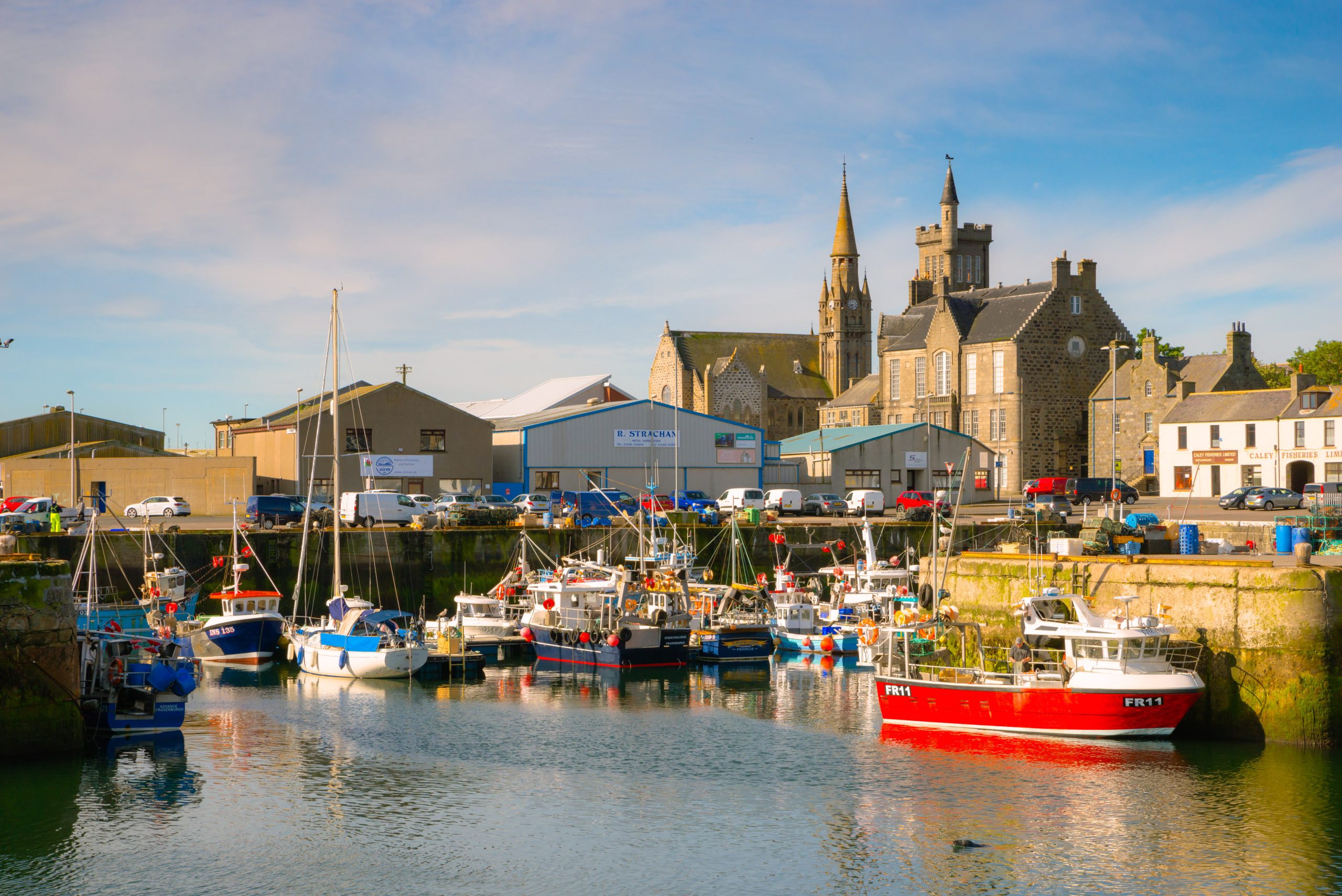
Fraserburgh remains a major working fishing port, particularly important for shellfish and the wider catching and processing economy. Fishing vessels, market activity, seals and seabirds make this an active industrial shoreline, not simply a historic harbour preserved for visitors.

Beach · Local Nature Reserve
Fraserburgh Beach and Waters of Philorth
Fraserburgh Bay forms a long arc of sand backed by a substantial dune system. At its eastern end, the River Philorth creates an estuary and Local Nature Reserve where boardwalks cross the dunes and migrating waders and wildfowl feed on the wetland and shoreline.

Community museum · Global connections
Fraserburgh Heritage Centre
Founded by local volunteers, the centre tells more than four centuries of the town’s history. Its collections range from fishing and family life to Thomas Blake Glover’s role in modern Japan and the work of Fraserburgh-born fashion designer Bill Gibb, revealing connections far beyond the harbour.

Geology · Lifesaving history
New Aberdour Beach
The beach is backed by striking sandstone caves and a shoreline rich in local tradition. St Drostan is said to have landed here in the sixth century, while a memorial recalls Jane Whyte, who helped rescue the crew of the wrecked steamship William Hope in 1886.

Fishing village · Film culture
Pennan
Pennan occupies a narrow shelf between cliff and sea, with houses turned gable-end towards North Sea weather. The village’s red telephone box became internationally familiar through Bill Forsyth’s Local Hero, adding a modern cultural layer to a settlement shaped by fishing and physical constraint.

Fishing village · Coastal form
Crovie
Crovie is compressed into an exceptionally narrow strip between the cliff and the sea, with no road running through the historic village frontage. Its closely packed houses preserve the form of a fishing settlement in which every metre of sheltered ground mattered.

River mouth · Open coast
Banff Beach and Links
Banff’s beach and open Links lie beside the mouth of the River Deveron, looking across to Macduff and the Moray Firth. Sand, rock, river and open grassland meet here, while the estuary creates changing conditions for birds, marine life and people moving along the shore.

Community ownership · Harbour reuse
Whitehills Marina
Once a successful commercial fishing port, Whitehills has adapted as a village-owned marina serving leisure sailors. The harbour shows how community ownership and new maritime uses can keep historic infrastructure active while retaining the village’s close relationship with the sea.

Maritime history · Engineering
Kinnaird Head and the Museum of Scottish Lighthouses
A 16th-century Fraser castle became Scotland’s first mainland lighthouse in 1787. Robert Stevenson later engineered a lighthouse tower and spiral stair through the heart of the castle, and the national museum now tells the story of the keepers, lenses and engineering that protected Scotland’s coasts.

Castle ruins · Jacobite history
Pitsligo Castle
Above Rosehearty stand the substantial ruins of the seat of the Forbes Lords of Pitsligo, with courtyard ranges, towers and the remains of formal gardens. Alexander, fourth Lord Pitsligo, supported the Jacobite cause, and the castle was destroyed after the rising of 1745.

Working harbour · Fishing heritage
Rosehearty Harbour
Rosehearty grew around fishing and coastal trade, with its harbour closely linked to the neighbouring lands of the Lords of Pitsligo. Heavy stone piers now shelter small boats and frame a village shoreline where maritime work, community memory and exposed North Sea weather meet.

Archaeology · Sheltered bay
Cullykhan Bay and Fort Fiddes
A sheltered sandy cove lies below Castle Point, where earthworks mark Fort Fiddes, a defended headland with a long history of occupation. The surrounding coast opens views towards Pennan and Troup Head and includes the dramatic sea cave known as Hell’s Lum.

Fishing village · Harbour and heritage
Gardenstown
Known locally as Gamrie, Gardenstown was founded in 1720 by Alexander Garden and climbs steeply from a compact harbour. Creel boats, tightly packed houses, cliff paths and the seasonal heritage centre tell the story of a fishing community shaped by the narrow ground between hill and sea.

Architecture · National art collection
Duff House
William Adam’s great 18th-century baroque house stands beside the River Deveron as both a historic property and a country-house gallery. Paintings and decorative art from the National Galleries of Scotland fill its rooms, while its wartime use as an internment and prisoner-of-war camp adds a very different chapter.

Museum · Silver and regional collections
Banff Museum
Founded in 1828, Banff Museum is the oldest museum in Scotland north of Perth. It is especially known for its collection of Banff-made silver—including an exceptional bullet teapot—alongside archaeology, geology, natural history and objects tracing the life of the former county town.

Working port · Historic viewpoint
Macduff Harbour and the Temple of Venus
Macduff’s harbour developed from an 18th-century basin into a fishing and boat-repair centre facing Banff across the Deveron. Paths climb from the waterfront towards the Hill of Doune and the 1737 Temple of Venus, William Adam’s domed folly overlooking Banff, Macduff and the surrounding coast.

Marine life · Moray Firth
Macduff Marine Aquarium
Dedicated to the Moray Firth, the aquarium interprets native marine life from the shore to deeper water. It is temporarily closed while a major extension and refurbishment are completed, so check the official aquarium website for the latest reopening information before travelling.

Art Deco · Community regeneration
Tarlair Outdoor Swimming Pool
Built in the early 1930s within a dramatic rocky inlet, Tarlair combines three seawater pools with a streamlined Art Deco pavilion. Community-led restoration has brought the award-winning pavilion back into use, while the pools themselves remain part of a longer-term restoration effort.
Portsoy to Cullen
A compact stretch rich in boatbuilding, salmon fishing, secluded bays, cliff paths and castle remains.

Living heritage · Boatbuilding
Portsoy Harbour, Salmon Bothy and Boatshed
Portsoy’s Old Harbour dates from 1692. The listed Salmon Bothy was built in 1834 for the salmon trade and now houses a museum in its former ice chambers, while the Boatshed keeps traditional boatbuilding and woodworking skills alive through hands-on volunteer projects.

Bay · Fishing village
Sandend Beach
Sandend is a compact sandy bay with a former fishing village gathered at its eastern end. The beach sits between rocky headlands and open farmland, while nearby Glenglassaugh and the coastal paths towards Findlater place it within a landscape of fishing, farming and distilling.

History · Cliff-top stronghold
Findlater Castle
The castle clings to a narrow, naturally defended promontory between Sandend and Cullen. Much of what survives belongs to a 14th-century rebuilding influenced by the layout of Roslin Castle, and the precarious site makes the relationship between medieval defence and coastal geology immediately visible.

Secluded bay · Coastal landscape
Sunnyside Beach
Sunnyside lies in a deeply indented bay reached on foot between Cullen and Sandend. Cliffs, rock pools and a broad arc of sand create a strong sense of enclosure, while the nearby remains of Findlater Castle add a human history to what otherwise feels like a remote stretch of coast.

Geology · High coastal path
Logie Head
Logie Head rises steeply above the Moray Firth and is known for its rock faces, seabird nesting sites and expansive views. The path towards Cullen and Findlater can be narrow, steep and exposed; the Giant’s Steps, built by hand in 1989, are a distinctive piece of recent local path-making.
02 · Local trails
Established routes along our coast
Communities and councils have developed routes that help people explore particular stretches of our coast. We’re working with the people behind these routes, building on what they have achieved and strengthening the links between them as the wider Doric Way develops.
Please check the latest information before setting out, as erosion, weather, tides, land management and temporary diversions can affect conditions.

Mearns Coastal Heritage Trail
Johnshaven to St Cyrus
This community-led route connects Johnshaven and St Cyrus through a coast shaped by fishing, farming, wildlife and the North Sea.
Since 2019, the Mearns Coastal Heritage Trail group has worked with the Tangleha Artists Collective, local volunteers and Aberdeenshire Council to develop and care for the route. Their work has restored difficult sections, responded to erosion and helped people reconnect with the natural and cultural heritage of the Mearns.
Read about the Mearns trail
Aberdeen Coastal Trail
Cove Bay, Torry, the harbour and Aberdeen Beach
Aberdeen City Council’s self-guided trail introduces the landscapes, wildlife and communities along the city’s coastline, from Cove Bay and the southern cliffs through Torry, Girdleness, the harbour, Footdee and Aberdeen Beach.
The guide brings together walking information with stories of geology, fishing, maritime industry, coastal defence and the city’s changing relationship with the sea. It is a valuable foundation for the Aberdeen section of The Doric Way.
Open the Aberdeen trail guideMore local trails to explore
These shorter heritage trails offer excellent ways to explore individual communities and understand the stories behind the places The Doric Way will connect.

Peterhead Trail
Town centre, Buchanhaven and Peterhead Prison Museum
Twenty-six storyboards tell Peterhead’s story through three self-guided routes: a shorter town-centre walk, a longer coastal route passing Buchanhaven and an extension linking the town centre with Peterhead Prison Museum.
Together they explore fishing, whaling, harbour engineering, local characters and the wider history of a town whose identity has always been closely tied to the sea.
Explore the Peterhead Trail
Banff and Macduff Heritage Trails
Banff, Macduff and the River Deveron
Eight self-guided trails invite people to explore the neighbouring coastal towns at their own pace, with local voices helping to bring their buildings, harbours, landscapes and communities to life.
The themes include maritime and military history, wildlife, faith, town life and notable local people, revealing the different ways Banff and Macduff have developed on either side of the River Deveron.
Explore the heritage trailsThese routes were created and are cared for by their existing organisations, communities and public bodies. Please check the latest information from the route publisher before setting out, follow local signs and diversions, and report any path problems to the relevant organisation or local authority.
03 · Annual events and festivals
What’s on along our coast
The Doric Way is about more than getting from one place to another. It’s also about connecting people with the galas, festivals, traditions, music, food and community celebrations that bring our coast to life.
Have a look at the annual events happening along the coast and see what might fit into your visit. We don’t include weekly or monthly listings. Dates marked “to be confirmed” are established or recurring events whose 2027 arrangements haven’t yet been announced, so please check the organiser’s page before travelling.
Find an annual event
Filter by coastal area, location, month or event type.
Help us keep this useful
Have we missed something?
We try to keep this page accurate, but opening times, access, event dates and programmes can change — particularly for volunteer-run events and seasonal attractions. Please check the relevant organiser or attraction before travelling.
Know an annual event, local trail or place worth seeing between Montrose and Cullen that should be included? Get in touch and we will review it for the page.
Tell us about a place or event